

You Can't Replace a Genius.
(Except Tim Cook kind of did.)

When Steve Jobs died in 2011, the consensus was quiet but clear. Apple was finished.
Not immediately. But eventually. Because the thing that made them Apple was Jobs -- the taste, the vision, the reality distortion field. You couldn’t replace that. You could only watch the slow decline of a company that had lost its source of magic.
Tim Cook just stepped down as CEO after 15 years. Apple’s valuation went from $350 billion to over $4 trillion on his watch.
So much for that theory.

What Cook did at Apple is one of the most under-appreciated creative stories in business history. Not because he was a visionary in the Jobs mold. He wasn’t and never pretended to be. But because he understood something that the genius myth obscures: that creativity at scale is not about the person at the top having the best ideas. It’s about building the conditions where good ideas can survive the process of becoming real.
Jobs was the lightning strike. Cook was the infrastructure that made lightning useful.
The culture has a hard time valuing that. We’re obsessed with origin stories, eureka moments, the lone figure who saw what nobody else could see. It makes for a better narrative.
(It also leaves out most of what actually happens between the idea and the thing that ships.)
Most of the time, replacing the irreplaceable doesn’t work. Bands do it constantly and it almost never lands. Does anyone actually want to hear the new Linkin Park? I sure don’t.
When the voice that defined something is gone, the instinct is to find the closest substitute and hope nobody notices. That’s usually when things fall apart -- not because the new person isn’t talented, but because they’re trying to fill a shape that was made for someone else.
Cook never tried to fit Jobs’ shape. That’s what made it work.
Bob Iger did the same thing at Disney. He inherited a company that had lost its creative footing and rebuilt it -- not by becoming Walt Disney reincarnated, but by building the infrastructure and making the right bets. Pixar. Marvel. Lucasfilm. The vision wasn’t in the ideas he generated. It was in the conditions he created for other people’s ideas to thrive.
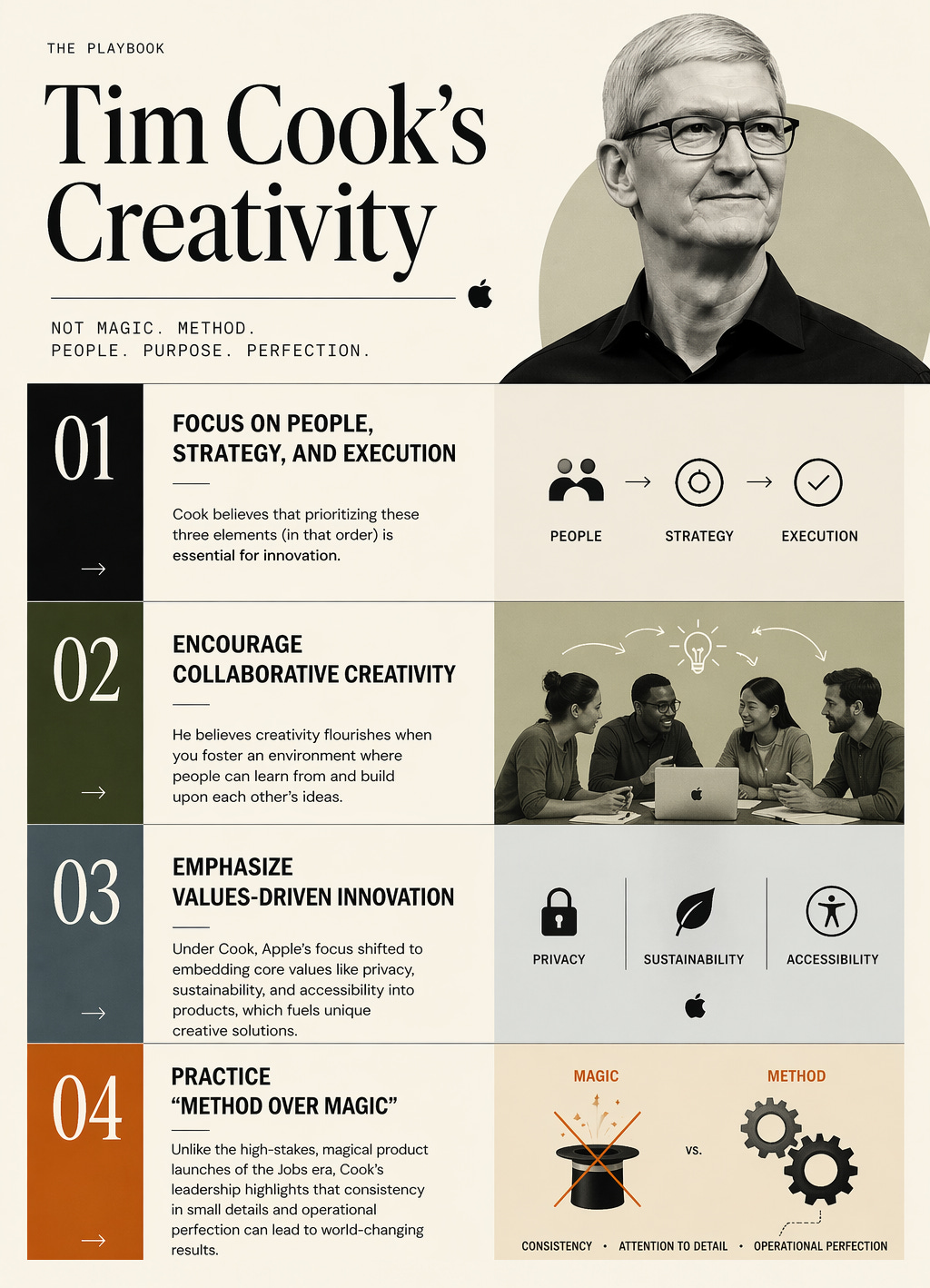
Cook’s version of creativity is less romantic and more demanding. It’s collaborative by design. It’s values-driven -- privacy, accessibility, sustainability weren’t talking points under his leadership, they were constraints that forced better solutions. It’s what he called method over magic. Consistency in the small details, operational discipline applied at enormous scale: a relentless focus on execution as a creative act in itself.
That’s not a lesser version of creativity. It’s a different one. And for most people doing creative work inside organizations -- which is most people doing creative work -- it’s the more relevant one.
The genius myth is seductive because it lets everyone off the hook. If great work requires a Jobs, then the absence of a Jobs is a reasonable excuse for ordinary work. Cook’s career is an argument against that excuse. The team matters. The process matters. The values that shape the decisions matter. None of it is glamorous. All of it compounds.
He also did something genuinely rare. He followed an impossible act without trying to become it. He didn’t chase Jobs’ ghost or perform a version of visionary leadership he wasn’t built for. He was exactly who he was, and it turned out that’s what the company needed.
That’s its own kind of creative confidence.
See you next week - and thanks for following along with Creative Exercise. - Mick