

The Iceman Cometh
What brand marketing knows about Drake’s comeback that hip-hop doesn’t. 🧊


Iceman drops tomorrow: May 15.
Drake’s first solo album in three years. His first since Kendrick Lamar took him apart in front of everyone and then performed the victory lap at the Super Bowl.
Personally, I’m excited. As a deejay, parties are honestly better when new Drake songs are in the mix.
But the hot takes have been predictable. Is he cooked? Can he get it back? Does hip-hop forgive?
Wrong conversation.
The question a brand strategist asks is simpler: is he doing this right?
Because what is actually happening here is not a comeback album. It is a brand rehabilitation campaign with a music release at the end of it. And when you look at it that way, Drake is doing something a lot more deliberate than the culture wants to acknowledge.
Start with the catalog, because most people are sleeping on it.
2014 was the low point for U.S. recorded music revenues. Streaming changed everything starting in 2015. In the eleven years since, two artists have put up a run without a single off year. Taylor Swift is one. Drake is the other.
A project nearly every year. Mixtapes, albums, collabs, surprise drops. That consistency built something that most artists never get: a catalog deep enough to work without him. Every new release pulls people back into the old songs. Like Biggie said, his game just rewinds.
(Full disclosure and a humble brag: Drake once said a mixtape I made at the beginning of my career was pivotal in his inspiration.)
Luminate data puts his U.S. total at 82.9 million album equivalents from 2015 through May 12th of this year. Through the first third of 2026, with Iceman still sitting unreleased, he had already logged 4.1 million. That is a pace of around 12 million for the full year. Before the album dropped, 2026 was already on track to be his biggest year ever in the U.S.
The narrative says Drake is wounded. But the numbers say he never stopped.
That distinction matters. He is not an artist trying to claw back relevance from scratch. He is a dominant catalog with a perception problem. Those are completely different situations, and they call for completely different moves.
Brands blow up their own trust all the time.
Johnson and Johnson pulled Tylenol off shelves in 1982 and came back stronger. Samsung recalled the Note 7, ate a billion-dollar loss, and launched the S8 to some of the best reviews they had ever gotten - although it still fucks up my group chats. 🙂
Domino’s ran a whole campaign admitting their pizza was bad, put their own focus group footage on television, and watched sales go up 14 percent.
None of those are music stories. But they all follow the same pattern. Consumer researchers call it trust recovery sequencing. The steps are counterintuitive. They go against every instinct. And Drake is running the playbook almost to the letter.
The most telling thing is what he is not doing.
He is not apologizing. Which is not ego... it is actually the right call.
The research is pretty clear that straight apologies do not move audiences who feel like the brand let them down personally. What they want is not sorry. What they want is proof the thing they believed in is still worth believing in.
When Tiger Woods went back to number one after losing Gillette, AT&T, and Gatorade all at once, Nike did not run a mea culpa. They ran four words: Winning takes care of everything.
(Although, apparently, opioids do not.)
Last year, Drake released “What Did I Miss?” That is not an apology. It is not even really a statement. It is a reframe: one that puts the audience in the position of having been away from something great, rather than Drake in the position of having fallen. Intentional or not, that is sharp branding.

Then there is the ice block. 🧊
Passive awareness does not rebuild loyalty. Participation does. When people do something - even something small - in relationship to a brand, it creates an investment that watching from the outside cannot.
Drake put a 25-foot block of ice in downtown Toronto with the album release date frozen inside it. People showed up with torches. The fire department got involved. A streamer named Kishka found the date, drove to Drake’s house, and walked away with $50,000 cash.
That is fantastic activation design. Brands spend millions trying to engineer exactly that dynamic: get people physically inside the story before the product even exists, so that when it drops, it is already partly theirs.
And the Pinocchio stuff is smarter than it looks.
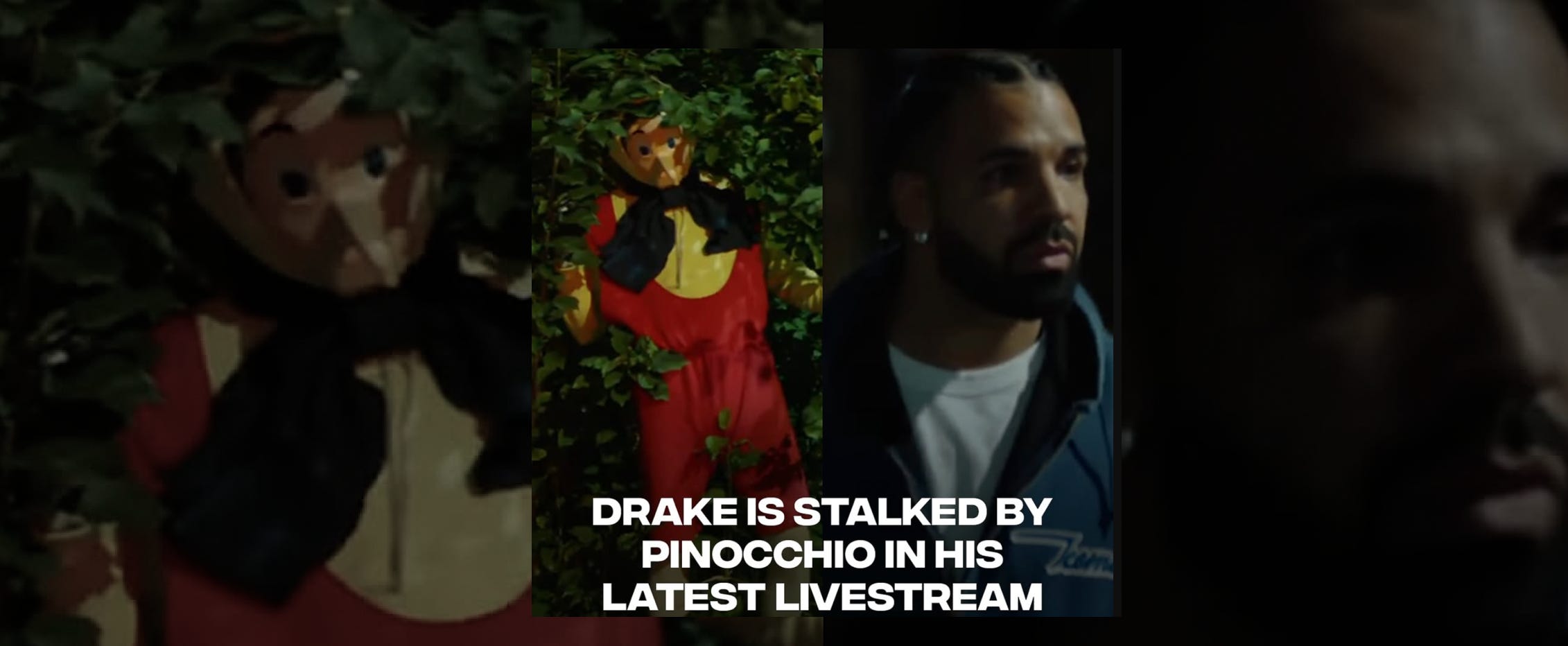
Every Iceman livestream has this recurring motif - Pinocchio characters showing up in different scenes, one writing the word LEGACY in red paint and dropping ice cubes on it. Drake confronts them at the end.
“Not Like Us” called him a liar. Pinocchio is the lying character. He is not running from that. He is pulling it inside the campaign and flipping it.
Kevin Durant did something similar with CeraVe. After years of being cast as the villain - the guy who left OKC, the burner accounts, the thin skin and apparently the dry skin - he leaned into the bit. Became the face of a drugstore skincare brand. Made it weird on purpose. The self-awareness disarmed the criticism in a way that defending himself never could.
That is the move. Ignore the thing and you look delusional. Dwell on it and you keep the wound open. The brands that actually come back find the narrow path - just enough acknowledgment to show you are not hiding, and then you move.
The one thing the campaign cannot control is whether the music is good.
That is always true. Johnson and Johnson’s recovery worked because the product was safe. Samsung’s worked because the S8 was actually great hardware. The campaign opens the door. The product has to walk through it.
Drake can do everything right and still drop an album that does not land. The rollout cannot save bad music.
But the cultural conversation around this moment keeps framing it as a rematch - like Kendrick is still in the room, like this is still a battle. It is not. That fight is over. This is something different. The question is not whether he beats anyone. It is whether the people who still have some investment in him decide the new thing is worth their time.
Let’s see what happens. 🧊
Creative Exercise is a newsletter about creativity, culture, and the business of both. Written by MICK.